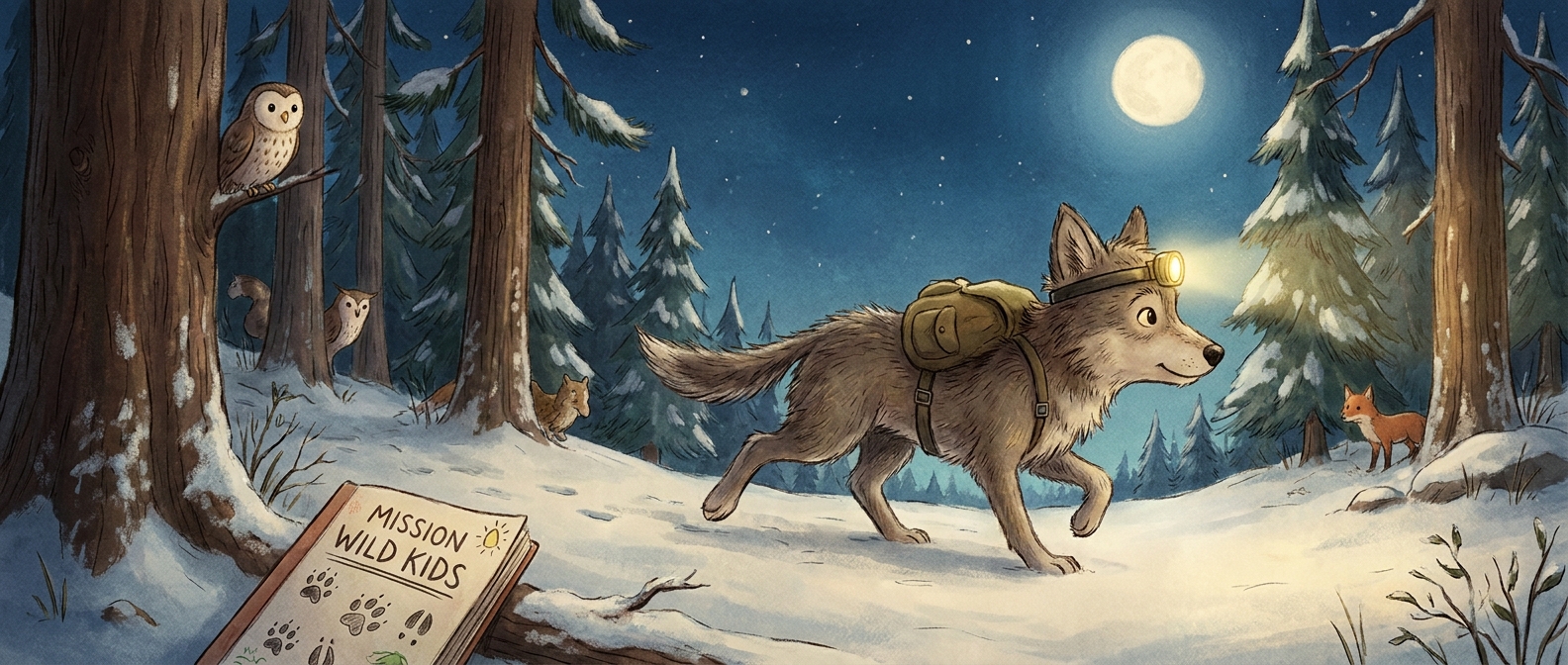
Moonlight slips through the pines, fresh tracks cut across the snow-dusted trail, and one young wolf is heading away from the safer pack route. Read the forest, trust the scent clues, and help Nova find the right path home.
Story setup
The forest is quiet in that strange way that makes every sound feel sharper. Frost shines on fallen needles. Tree trunks throw long blue shadows across the trail. Then a low howl rises somewhere deeper in the woods, followed by a much lighter answer from the wrong side of the ridge.
This is Nova, a young wolf who has drifted away from the safer pack line and is cutting toward a harder stretch of forest where gullies, weak snow bridges, and confusing scent trails can break the route home.
Your mission is not to chase Nova through the dark. Your mission is to read the tracks, notice the forest clues, and guide the safe route back toward the pack line.
Learning goalUnderstand how wolves use packs, trails, and scent information to move safely through large territories
Mission pressureNight visibility, split trails, weak snow, and a young wolf drifting toward the wrong side of the ridge
Start missionNova needs the pack line, not the quiet trap trail.
Rescue step 1
Read the trail split
🐺
You find two sets of tracks. One route follows older packed prints through the trees. The other cuts fresh toward a narrow gully. Which path makes more sense first?
What you learned
Wolves often use repeated pack routes. Group trails can reveal safer movement paths through large, difficult habitat.
A pale stretch of snow crosses a shallow creek. One side looks smooth and hollow. The other has older broken prints and fir needles scattered across the top.
What you learned
Snow changes the safety of trails. Texture, debris, and past use can all reveal stronger routes through winter ground.
Near the ridge turn, one route smells sharply of open wind and cold rock. The other carries stronger forest scent, musk, and the layered smell of repeated animal movement.
What you learned
Wolves use scent, cover, and repeated territory routes. Safe movement often depends on the layered signals of a route already trusted.
Nova slows near the deeper pines, turns once toward the darker timber, and then slips into the stronger pack trail where larger prints and familiar scent lead safely through the woods.
You helped Nova the Wolf by reading the tracks, trusting the pack route, and choosing the forest logic that made the safe path clear again.
Badge unlockedPack Trail Tracker earned
Mission result
You handled this one like a real night tracker, pack route first, terrain second, then safe rejoin.
What you learned
Wolves depend on packs, repeated trails, sound, scent, and terrain awareness. Night movement is about reading the full environment.
Mini game unlockedWolf Pack Line is now live in Explorer HQ
Head to Explorer HQ to play the unlocked Wolf Pack Line mini game and prove you can track the safest route through the forest.
Why was the older pack trail safer than the fresh path that looked more dramatic?
Come back tomorrow
Try fox next for another tracking mission, or snow leopard if your explorer wants the harder mountain version.
What kids learned
Wolves often use repeated pack routes through their territory
Sound direction changes in forests and along ridges
Snow texture can reveal safer and riskier crossings
Scent and cover help animals choose stronger paths
Helping wildlife often means restoring the route, then stepping back
Badges earned
Pack Trail Tracker
Night Scent Reader
Forest Logic Expert
Parent and teacher note
This mission teaches evidence ranking, pack behavior, terrain reading, and the idea that the safest route is often the one already tested by the animal group.
Skills practiced: comparison, inference, tracking, and evidence-based reasoning