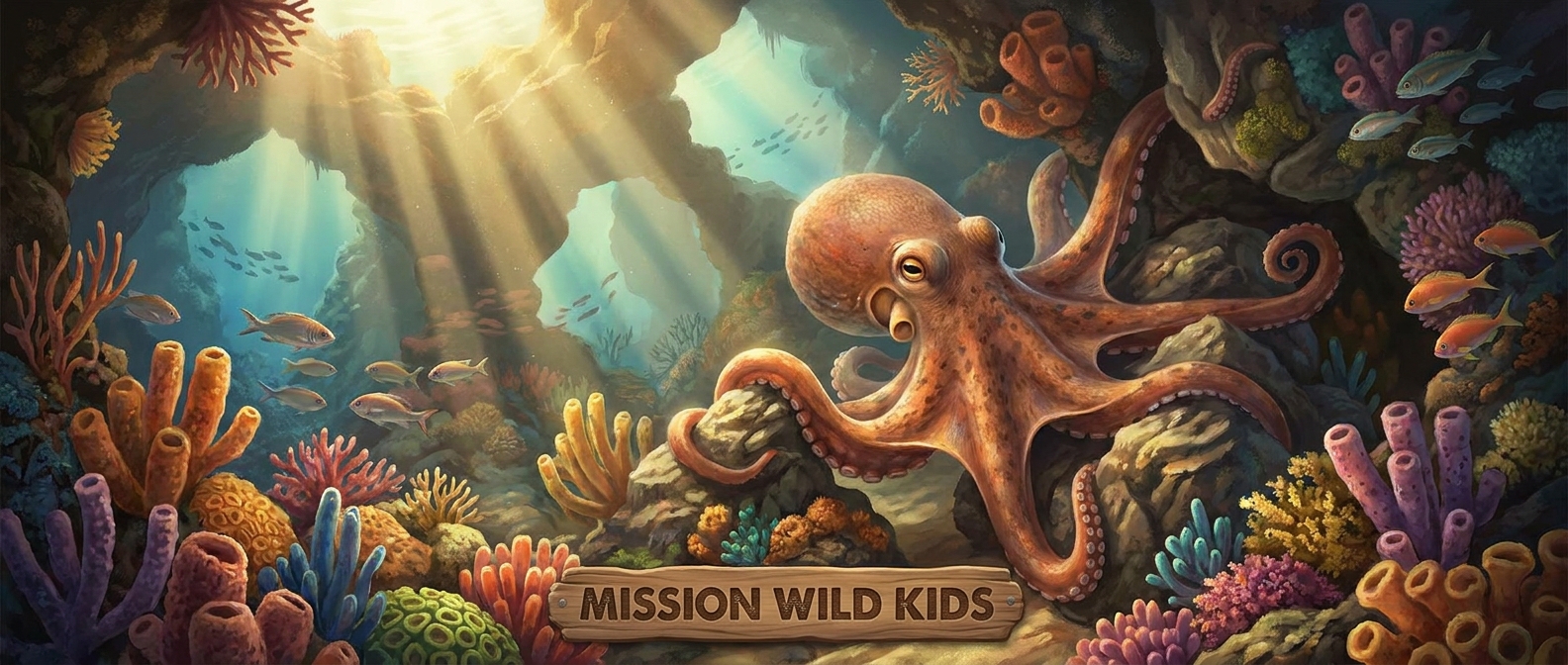
The reef is full of cracks, shadows, and changing colors, and one brilliant octopus is trapped in the wrong maze. Think like a puzzle-solver, read the reef, and help Ink find the hidden route home.
Story setup
Light ripples through the water and flickers over coral towers, sea fans, and dark stone cracks. Tiny fish flash silver, then disappear. That is when you notice a shape change right in front of you, first rock, then shadow, then suddenly octopus.
This is Ink, a clever octopus who slipped away from the safer reef cave and into a maze of tight passages where predators and strong currents can trap even a smart animal.
Your job is not to chase Ink. Your job is to read the reef like a puzzle, find the quiet route, and help this master of camouflage choose the safest escape.
Mission score:0/5
Start the mission
Mission toolsCamouflage clues, reef gaps, current direction, hiding spots, and quiet paths
Learning goalUnderstand camouflage, problem-solving, reef habitat logic, and how octopuses use the environment intelligently
Mission pressureTight spaces, shifting color, strong water movement, and a brilliant animal making split-second choices
Start missionInk is a reef puzzle-master, but even smart animals need a safe route home.
Rescue step 1
Spot the disguise
🐙
Ink changes color and texture to blend into the reef wall. What clue helps you tell where the real octopus is hiding?
What you learned
Octopuses can change color and even skin texture to match rocks, coral, and sand. They hide by changing pattern, shape, and posture, not just color.
Ink flashes one last swirl of color, slides through the coral shadows, and disappears into the tucked-away reef cave. A second later, one curious eye peeks out, then vanishes again into the dark.
You helped Ink the Octopus by solving the reef like a puzzle, choosing cover, and reading the water instead of chasing the first bright path.
Badge unlockedReef Puzzle Master earned
Mission result
You solved this one like a real reef thinker, pattern, cover, route, then finish.
What you learned
Octopuses rely on camouflage, shelter, and intelligence. Reef safety is not random. It is a puzzle of current, cover, and escape routes.
Why was the sheltered reef cave safer than the bright open-water route?
Come back tomorrow
Try dolphin next for another ocean logic mission, or sea turtle for a different kind of coastal clue-reading.
What kids learned
Octopuses can camouflage using color, pattern, and texture
Reef safety depends on cover, caves, and quieter water
Open bright water is not always the safest route
Problem-solving helps animals survive in complex habitats
Safe rescue often means helping the animal find the route it already wants
Badges earned
Reef Puzzle Master
Camouflage Clue Finder
Deep Explorer
Parent and teacher note
This mission teaches pattern recognition, camouflage, route comparison, and the idea that safe shelter can matter more than obvious open space in reef habitats.
Skills practiced: observation, inference, comparison, and puzzle-solving
Science concept: camouflage, reef shelter, and animal adaptation
Classroom extension: ask students to explain why an animal might prefer cover even when open water looks easier