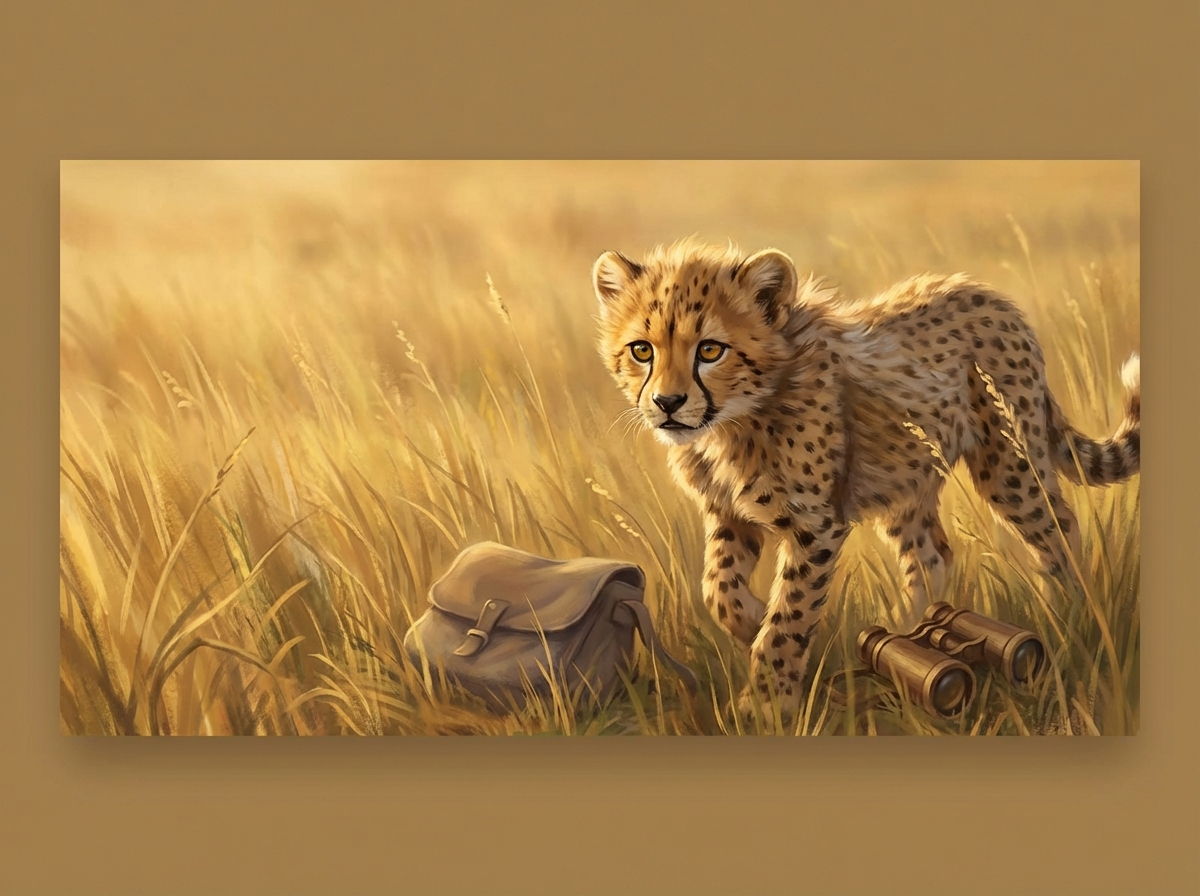
The grass is tall, danger is close, and one fast mistake could expose a cheetah cub to the whole savanna. Smart timing is what keeps Nia alive.
Story setup
The savanna feels endless, gold grass waving under a hot breeze. Somewhere nearby, guinea fowl chatter and then go suddenly quiet. That is when you notice movement low in the grass.
A young cheetah cub is crouched so still she almost disappears. Her name is Nia. She is alone for the moment, and that is dangerous, because the savanna is full of animals that notice weakness fast.
Cheetah cubs survive through camouflage, timing, and a mother that knows exactly when to move and when to freeze. Your mission is to help Nia stay safe until she can reconnect with her mother.
Mission score:0/4
Start the mission
Mission toolsStay low, watch movement, choose cover, and move at the right moment
Learning goalUnderstand how speed, camouflage, timing, and energy control work together in the wild
Mission pressureOpen grassland, hidden predators, and a cub that cannot afford to waste speed at the wrong time
Start missionNia survives by staying hidden, reading the moment, and moving only when it is smart.
Rescue step 1
Use cover first
🌾
Nia hears movement in the grass. The birds have gone quiet, the wind has shifted, and something out there just changed. If she breaks cover too early, the whole savanna could notice. What should she do first?
What you learned
Cheetah cubs are vulnerable when young. Their spotted coats and low posture help them blend into the grass and stay harder to see. Young cubs survive by staying hidden far more often than by running.
A flock of birds suddenly lifts off nearby, and even the antelope farther out raise their heads at the same time. It is like the grass itself is whispering that danger has moved one square closer.
What you learned
Wild animals often learn by reading other animals. Birds, antelope, and even insects can signal when something nearby has changed before a predator or cub is directly seen.
Nia sees a strip of open ground ahead and thicker cover off to the side. The open route is shorter, but everything on the savanna can see it. The covered route is slower, but it keeps the mission alive.
What you learned
Cheetahs are famous for speed, but they do not waste energy. They can only hold top speed briefly, which means cover and timing often matter more than raw sprinting.
You spot an adult cheetah shape in the distance, half-hidden by grass and heat shimmer. It may be Nia's mother. This is the last stretch, and the wrong burst of panic could turn a safe reunion into a dangerous chase.
What you learned
Young cheetahs depend on their mothers for food, protection, and survival skills. Calm reconnection matters more than dramatic action, because panic can draw the wrong kind of attention.
Nia stays hidden, moves only when the moment is right, and reaches her mother safely. For a second, both cheetahs pause in the grass, nearly invisible except for one flicking tail.
Then they slip away together before danger gets close.
You helped Nia the Cheetah Cub by using patience, observation, and timing instead of panic.
Mission result
You solved this one like a real tracker. You noticed patterns, took the safer route, and avoided the flashy wrong move.
What you learned
Cheetahs are fast, but smart survival is not just speed. It is reading the moment, using cover, conserving energy, and moving only when the odds improve.
You unlocked the Cheetah Timing Sprint mini game on the progress page. More missions unlock more challenge cards.
Adventure result
You won this rescue by reading the moment, protecting cover, and refusing the flashy wrong move.
Discussion question
Why was waiting for the safer moment smarter than using speed too early?
Come back tomorrow
Try a different habitat next, sea turtle for light and beach clues, or falcon for air and route clues.
What kids learned
Cheetahs use speed at the right moment, not all the time
Cubs rely on camouflage, cover, and stillness to survive
Wildlife clues often come from other animals, not just the animal you are watching
Cheetahs cannot waste energy because top speed only lasts a short time
Timing can be safer and smarter than rushing
Badges earned
Cheetah Scout
Speed Strategist
Cheetah Expert
Parent and teacher note
This mission teaches patience, pattern recognition, camouflage, animal behavior, and the idea that fast animals still survive through judgment, not just speed.
Skills practiced: timing, clue-reading, comparison, and impulse control
Science concept: predator behavior, camouflage, and energy conservation
Classroom extension: ask students to explain when waiting is smarter than acting fast in another habitat